
'Modi's decision to hold out an olive branch to Sharif within 48 hours of the 'surgical strikes' has been a timely move as it helps tensions to 'de-escalate',' says Ambassador M K Bhadrakumar.

Imran Khan knows Pakistan is holding a strong hand and doesn't have to flaunt it while claiming victory. But Pakistan has learned from the experience of the 1990s -- high risk of going out on a limb, asserts Ambassador M K Bhadrakumar.

With Shanghai Cooperation Organisation set to admit India and Pakistan amid growing rancour over their Nuclear Supplies Group membership bid, a Chinese state-run daily expressed concern on Friday that the hostility between them may have a "negative effect" on the security grouping.
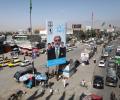
As Afghans head to the polling booths to elect a new president, a contested and fraud-marred elections could potentially throw Afghanistan into a renewed cycle of violence and instability, says Dr Shanthie Mariet D'Souza.

'It was deliberate,' the Russians allege.

A day after North Atlantic Treaty Organisation forces transferred security responsibilities to Afghan authorities, the United States has said will continue to work with India, Pakistan and Afghanistan to further strengthen the regional security.

'If the US intention was to use the FATF platform to isolate Pakistan and impose sanctions against it, that is not going to work when influential countries such as Turkey, Iran, Saudi Arabia, China and Russia will not lend support to the US campaign,' says Ambassador M K Bhadrakumar.
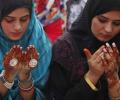
'The osmosis between Hinduism and Islam that really gave birth to the Hindustani or Indo-Islamic civilisation was due to the conversation between Muslim mystics and yogis.'

'Overlying his idealism was a hatred of war and of all things military. He gave no deep thought to politico-military matters and this prevented him from making sound security decisions.'
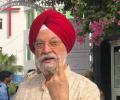
In his book Arun Bhatnagar, a retired IAS officer, makes a dig at Hardeep Singh Puri, former diplomat, Union minister and BJP nominee from Amritsar Lok Sabha seat, for Rajiv's faulty Sri Lankan policy, writes Rasheed Kidwai.

'The impasse on the India-China border in the Sikkim sector persists, but the Hamburg meeting between the two leaders will certainly have its salutary effects on the relationship between the two countries,' says China scholar Rup Narayan Das.

'If Indian armed forces entered Pakistan and succeeded in inflicting major damage on the Pakistani army and occupied territory in the Pakistani heartland, there is reason to think the Pakistani military would use some nuclear weapons against the incoming Indian forces to compel India to stop.'
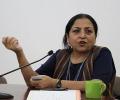
Madhu Kishwar is a patriot whose freedom of expression needs to be supported by all, especially the liberals, says Sankrant Sanu.
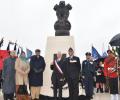
'The Indian Army served with honour and distinction in France and Flanders, East Africa, Gallipoli, Aden, Egypt, Mesopotamia, Palestine, Transcaspia, Persia and even China.' 'The sacrifice of India's soldiers was consigned to the dustbin of history in the post-colonial world.'

In its explanation of vote, India said 'we find that our views have not been reflected in the draft being considered for adoption today. We would like to reiterate that a consultative and constructive approach involving the neighbouring countries and the region, remains important as the international community strives for the peaceful resolution of the issue'.

Strategic consideration were the reasons behind frequent meetings between United States President Barack Obama and Prime Minister Narendra Modi, Chinese state-run media said on Wednesday and cautioned India that it cannot rise by "containing" China or picking one side against the other.

'What his minions do, we are not sure, but he has got to keep them under control. Pogroms against Muslims in India -- I don't think that is going to be his policy.'

The question really is whether the US can be persuaded to embark on a path of calibrated and stronger sanctions on Pakistan.

India should enhance its economic, cultural and defence ties with Mongolia. It is high time Modi should focus on gaining clout in smaller Asian countries such as Mongolia. It is in this context, India's engagement with Mongolia would give much-needed impetus to India's foreign policy, says Sana Hashmi.

'As of now, it may be best for India to insist that Yameen honours the supreme court rulings and ensures that the next election is free and fair,' says Brigadier S K Chatterji (retd).

'It will make good sense for military men on that side of the table to be confronted by our own.'

'If the US-Pakistan relationship continues to suffer, Pakistan may feel it has less to lose and decide that it need not keep a leash on LeT in order to appease America.' 'A tougher US policy toward Pakistan could lead to an emboldened and strengthened LeT and JeM, resulting in more terrorist attacks in India.'
.jpg)
In cyber security, India's main concerns are Pakistani and Chinese espionage. Which is exactly why the US needs to build up partnership with India.
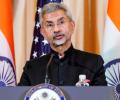
'What Jaishankar says is simplistic.' 'The past does not matter that much.' 'If we think that it does it is because we are not good enough at running the nation competently today and are searching for excuses why,' argues Aakar Patel.

If India is to follow a smart cultural diplomacy, it has unmatched advantages over both China and Pakistan, says Colonel Anil A Athale (retd).

'Even if the national security framework is to be threat-based, then the division of security threats between Pakistan and China is absurd. The two threats are one.'

"Though we reiterate our commitment to peace, our defence forces -- the army, the air force and the navy -- are adequately mobilised in a well-coordinated move to thwart any attempt to undermine our security. Our national interest will be protected at all costs. We have also ensured a widespread understanding in the international community of India's firm and principled stand," the President said. India and China are locked in a nearly nine-month long military standoff in eastern Ladakh.

'There is no holistic picture of our own goals and objectives.' 'For some inexplicable reason, the decision makers find it best to listen to their inner souls in dealing with these issues rather devising a carefully thought-out, structured plan,' says Vice Admiral Premvir Das (retd).

According to a report by the Institute for Economics and Peace, an independent, think tank dedicated to shifting the world's focus to peace as a positive and tangible measure of progress, India ranks 143rd

Prime Minister Narendra Modi had gone to China with a bagful of initiatives, but not all seems to have been fulfilled given China's reluctance to go the whole hog with him

'Nobody is going to fight India's war.' 'India has to fight its own war against the rogue State and the evil forces nurtured by it.'
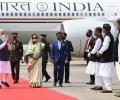
The South Asian nations could script a new history of cooperation and prosperity that could serve as an example for other nations, notes Dr Rahul Mishra.

Experts said India has possessed the anti-missile technology for several years but needed the political go-ahead to actually test it in live conditions.

India has made a good beginning in the area of satellite navigation but still there is a long way to go.

'He was always opposed to a form of nationalism that was narrow, selfish and arrogant.' 'He will always remain a beacon of inspiration for freedom-loving people across the world and for movements of resistance against oppressive State power.'

Remember the trees that bend during the storm will survive; the ones that try to defy and stand straight tend to get damaged and uprooted, points out management guru Virender Kapoor.

'We should build a military with the capability to fight today's war on priority -- balancing it with the requirements of the future,' says Lieutenant General Anil Chait, one of the Indian Army's most cerebral thinkers who recently retired as chief of the Integrated Defence Staff, in his agenda for the new defence minister.
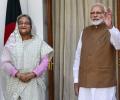
Shringla visited Dhaka in March last after assuming office of the Indian Foreign Secretary in January this year.

China's economy is worse than it really is, but then these are emblematic of the baffling self-congratulatory mood that exists in India today.

The failure to restructure our armed forces in line with contemporary needs 14 years after the Kargil war will impose strategic costs beyond just delays and scandals, says Nitin Pai
